🌐 I don’t care about the Vivaldi browser, but why must Apple suck?
Vivaldi Blog, September 28, 2026: Happy 3rd birthday, Vivaldi on iOS:
Globally, the only way to distribute apps for iOS and iPad iOS is through Apple’s App Store. Since the dawn of time, one of Apple’s rules requires that every app that browses the web uses Apple WebKit, the same browser engine that Apple uses to power Safari. You can’t choose which version of WebKit you use; it has to be the one that Apple ships, and it’s different from the one on the Mac.
...
So we delayed developing for iOS, hoping that the new EU Digital Markets Act (DMA) would require Apple to end its restrictions on competitors choosing their own tech stacks. The DMA was designed “to comprehensively regulate the gatekeeper power of the largest digital companies”, and it’s obviously anti-competitive for a Big Tech gatekeeper to limit the capabilities of its competitors.
But demand from our customers grew, and because we have no shareholders or investors pulling the strings, we listen to our community. So we built a team especially for iOS, and released the first version 28 September 2023.
Apple finally allowed non-Webkit browsers on iOS 17.4 in March 2024, and in September 2025 in Japan, under the Mobile Software Competition Act.
But we have not released a version using our preferred engine yet. Nor has any other browser vendor. Again, the reason for this is purely because of Apple. We were required to agree to a “Web Browser Engine Entitlement” purely to compile and test Chromium on iOS, and only on devices tied to Vivaldi’s developer account.
But the conditions Apple attaches to the entitlement make it impossible for a small independent browser company to distribute our preferred product. We would have to develop and maintain two iOS browsers, one for EU and Japan, and the other for the rest of the world. We would need to ask all our EU and Japanese customers to move to a new Vivaldi rather than simply push an update through the App Store, while agreeing that “Apple may, in its sole discretion, reject, or cease distributing Your Alternative Web Browser Engine App (EU) for any reason”.
Some basic questions about how Apple’s contract works remain unanswered, despite our asking them through Apple’s official DMA channels and sending follow-up nudges. Important questions such as what happens if an EU resident travels outside the EU –or vice-versa– as an estimated 600,000 commuters do every day (over 410,000 in Switzerland alone).
The constraints that Apple imposes are not inherent in permitting alternative browser engines. They bear no obvious relationship to protecting iOS security or integrity. They are simply designed to hamstring fair competition.
Vivaldi fights for a better web. We believe you have the right to run the software you want on a device that you own. During my two years at Vivaldi (and three years before that), I’ve been working alongside Open Web Advocacy and Browser Choice Alliance, talking with competition regulators in EU, UK, Japan, Korea, Malaysia, Australia, Brazil, Colombia and USA, to make the case for Vivaldi –and all other browsers– to be able to compete fairly on iOS, on Windows and Android.
And we’ve had successes. In the EU and Japan, browser engine choice is written into law. About 60% of the dark patterns Microsoft employed to push Windows users to use Microsoft Edge have been phased out in the EU. (As Mozilla’s independent Over the Edge 2 report shows, the situation is much worse outside the EU.)
After Vivaldi filed a formal DMA Interoperability Request, Google is implementing a way for all Android browsers to install Web Apps as first-class citizens, rather than reserving that for Chrome.
The UK competition regulator is investigating Microsoft’s business software and the WebKit browser restriction. In the USA, the Department of Justice has brought an anti-trust action against Apple.
Soon I’ll meet EU regulators with Apple and other browsers in Brussels to try to achieve a fairer way to ship our preferred engine on iOS and iPadOS. ...
I tried Vivaldi on Android, and I found it too banal to deserve consideration. Brave seemed much more interesting, despite my not loving it regardless of the platform.
But, but, but... Why are there dozens of Chromium-based browsers, but very few Gecko-based ones?
Since I mentioned Brave, here’s some shit from its makers: Claude Cowork on Amazon Bedrock with Brave Search: bringing real-time Web intelligence for your organization. With all their technical expertise, they weren’t able to post an ASCII graphic with properly aligned characters:
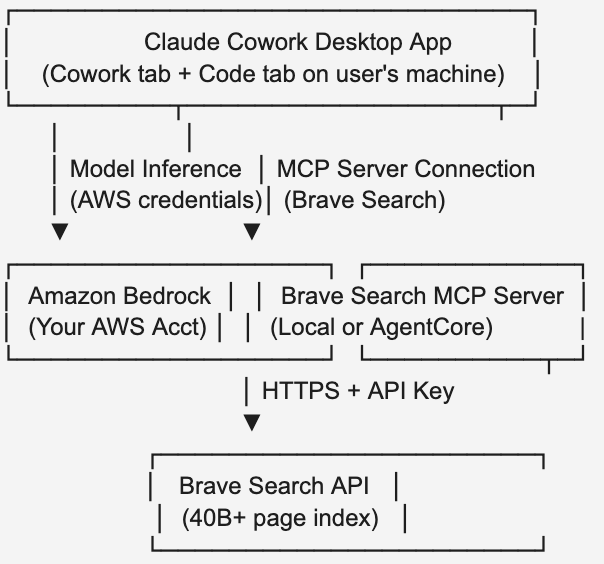
But I am supposed to trust their shit, eh?
BTW, Firefox 157 is a monumental piece of shit. I’m so happy that Debian 13 uses Firefox ESR 153.4! No surprises, no shit. But that fucking shit will come!